
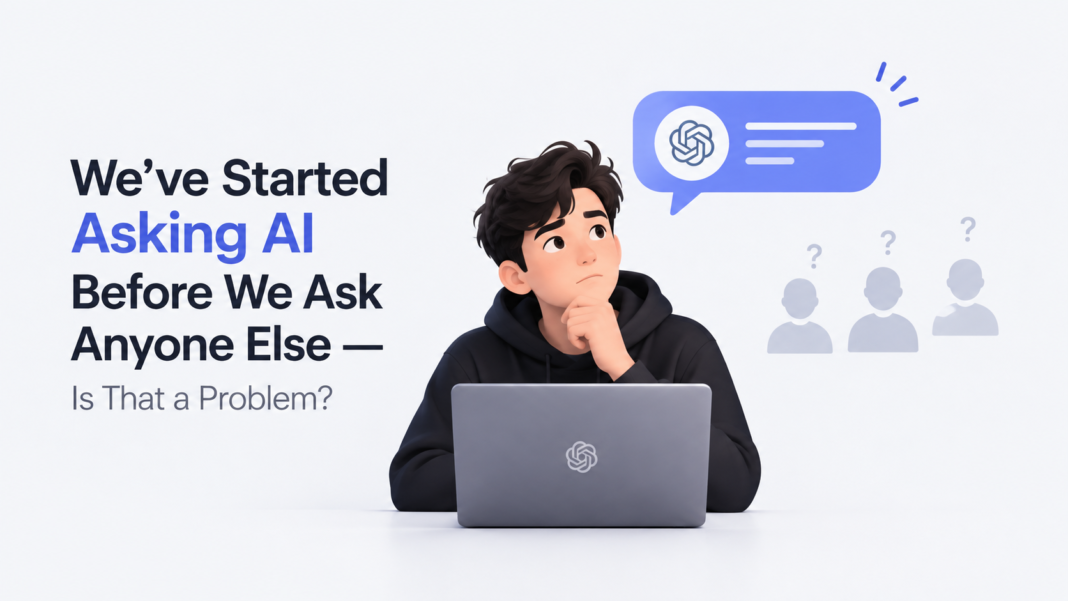


Somewhere in the last year or two, something quietly shifted. Nobody announced it, there was no big headline moment — but if you pay attention to your own habits, or just watch the people around you, it’s obvious. Before we ask a friend, a parent, or even do a quick Google search, a lot of us now open a chatbot first. Not just for work tasks. For almost everything.
The numbers back this up more clearly than you’d expect. A SurveyMonkey study tracking American AI usage found that a third of Americans now use AI on a daily or weekly basis, up from just a quarter of people a year earlier, and two-thirds of people say they’ve tried it at least once, a sharp jump from the year before. A separate national survey in Switzerland found something similar: 76% of Swiss adults now use AI tools daily, up from about 62% just a year earlier — and among 18 to 35-year-olds, that number jumps to over 90%. This isn’t a niche behavior anymore. It’s mainstream.
What’s more interesting than the raw adoption numbers, though, is what people are actually using AI for. A longitudinal study published through Harvard Business Review, which tracked AI use cases people voluntarily shared online across platforms like Reddit, Quora, and TikTok over nearly a year, found that around a third of people surveyed said they interact with AI several times a day — up from about a fifth of people just two years earlier. That’s not “I used it once for a work project.” That’s several times a day, every day.
Here’s where it gets personal, though, and where my own opinion on this starts to creep in. The Swiss survey found that while people are comfortable using AI for practical tasks like internet searches and writing, more than half — 55.5% — said they would not share psychological problems with a chatbot. That number tells two stories at once. On one hand, it shows people still recognize a line between “help me write this email” and “help me process what I’m feeling.” On the other hand, it means that roughly 44% of people would be open to it, or already are doing it. And that’s the part that quietly worries me.
I’ve noticed this in conversations with people around me too, and I don’t think it’s unique to any one country. Someone gets bad news, has a fight with a partner, or is anxious about a decision — and instead of calling a friend, they type it into a chatbot first. Sometimes it’s because it’s faster. Sometimes it’s because AI doesn’t judge, doesn’t get tired of listening, and never says “I don’t have time to talk right now.” Those are real, understandable reasons. But there’s a cost to it too: a chatbot doesn’t actually know you, doesn’t remember your history the way a person who’s known you for years does, and it can’t sit with you in a room the way a real person can. It can sound supportive without actually understanding what’s at stake for you specifically.
A peer-reviewed study out of Amity University, published in early 2026, looked directly at this — examining the relationship between AI dependence and overall well-being among young adults aged 18 to 26. The researchers noted that AI has become a regular part of daily life for young people especially, who now use these tools not just for studying and problem-solving, but to express themselves emotionally and for everyday guidance. That single sentence — using AI “to express themselves emotionally” — says a lot about where things have moved.
There’s also a workplace angle to this that’s worth mentioning, because it’s not all about emotional reliance. The same SurveyMonkey research found that among workers using AI daily or weekly, 37% said their productivity would actually drop if they lost access to it. And most of these workers taught themselves how to use it — 75% learned entirely on their own, with only a small fraction getting formal training. That’s a huge, fast behavior shift happening with almost no structure or guardrails around it, and only about a third of frequent workplace AI users say their employer even has clear rules about how it should be used.
None of this means AI is inherently bad, or that people are doing something wrong by using it constantly. A tool that answers questions instantly, never gets impatient, and is available at 3 a.m. when nobody else is awake is genuinely useful, and pretending otherwise would be dishonest. But there’s a difference between using AI as a tool and slowly routing more and more of our thinking, deciding, and even feeling through it by default. The concerning part isn’t the technology — it’s how invisible the shift has been. Nobody consciously decided to trust a chatbot with things they used to only tell a close friend. It just happened, one convenient conversation at a time.
Interestingly, even as usage climbs, trust hasn’t fully caught up. The same SurveyMonkey data found that despite growing reliance on AI, most Americans still say they value input from real people over AI-generated advice. That gap — using it constantly while still not fully trusting it — might be the most honest summary of where we all actually are right now.
FAQ
How many people actually use AI on a daily basis in 2026?
Survey data varies by country, but a U.S. SurveyMonkey study found a third of Americans use AI daily or weekly, while a Swiss national survey found 76% of adults use AI tools daily, with usage highest among 18–35-year-olds.
Do people use AI for emotional support?
Some do. A Swiss survey found that just over 55% of respondents said they would not share psychological problems with a chatbot, meaning a significant minority are open to it or already do.
Is AI dependency linked to wellbeing?
A 2026 peer-reviewed study from Amity University examined the relationship between AI dependence and physical, social, mental, emotional, and spiritual well-being among young adults, noting that many now use AI tools for emotional expression alongside studying and daily guidance.
Are workplaces regulating AI use?
Not really, based on current data. Among frequent workplace AI users, only about a third said their employer has clear guidelines in place, while nearly half said there were no rules at all.
Do people trust AI more than other humans now?
Not entirely. Despite rising usage, most people surveyed still say they value real human input over AI-generated advice, suggesting usage has outpaced actual trust.
EXTERNAL SOURCES
- SurveyMonkey — AI Sentiment Study, Q1 2026
- Let’s Data Science — Swiss Adults Adopt AI Tools For Daily Tasks
- Curious (Podcast/Research Summary) — How Are People Using AI in 2026? Here’s What the Data Says
- International Journal of Indian Psychology — AI Dependence and Its Relationship with Physical, Social, Mental, Emotional and Spiritual Well-Being