

There was a time when building software meant learning a programming language, understanding frameworks, writing hundreds or even thousands of lines of code, debugging errors, reading documentation, and spending hours trying to understand why one small feature was not working.
Today, the process can look completely different.
You can describe an idea in plain English, ask an AI tool to build it, review what appears on the screen, ask for changes, and continue the conversation until you have something that works.
This new approach has become widely known as “vibe coding.”
But is vibe coding really the future of software development? Or is it simply another way of using AI that has been given a catchy name?
In my view, the answer is somewhere in the middle.
Vibe coding is genuinely changing how people build software, but it does not mean that programming knowledge has suddenly become unnecessary.
What Exactly Is Vibe Coding?
The term vibe coding was introduced by computer scientist Andrej Karpathy in February 2025. The basic idea is simple: instead of manually writing every part of a program, you describe what you want in natural language and let an AI model generate much of the code.
For example, instead of writing HTML, CSS and JavaScript yourself, you might tell an AI:
“Build me a modern landing page for a technology company with a dark hero section, pricing cards, testimonials and a responsive mobile layout.”
The AI can generate the initial implementation.
You can then continue:
“Make the hero section smaller.”
“Change the colors.”
“Add animations.”
“Make the pricing cards responsive.”
This creates a different relationship between the human and the computer.
Traditionally, developers communicate with computers primarily through programming languages.
With vibe coding, the developer can increasingly communicate through intent.
And that is the interesting part.
Vibe Coding Is Not the Same as AI-Assisted Coding
I think this distinction is extremely important.
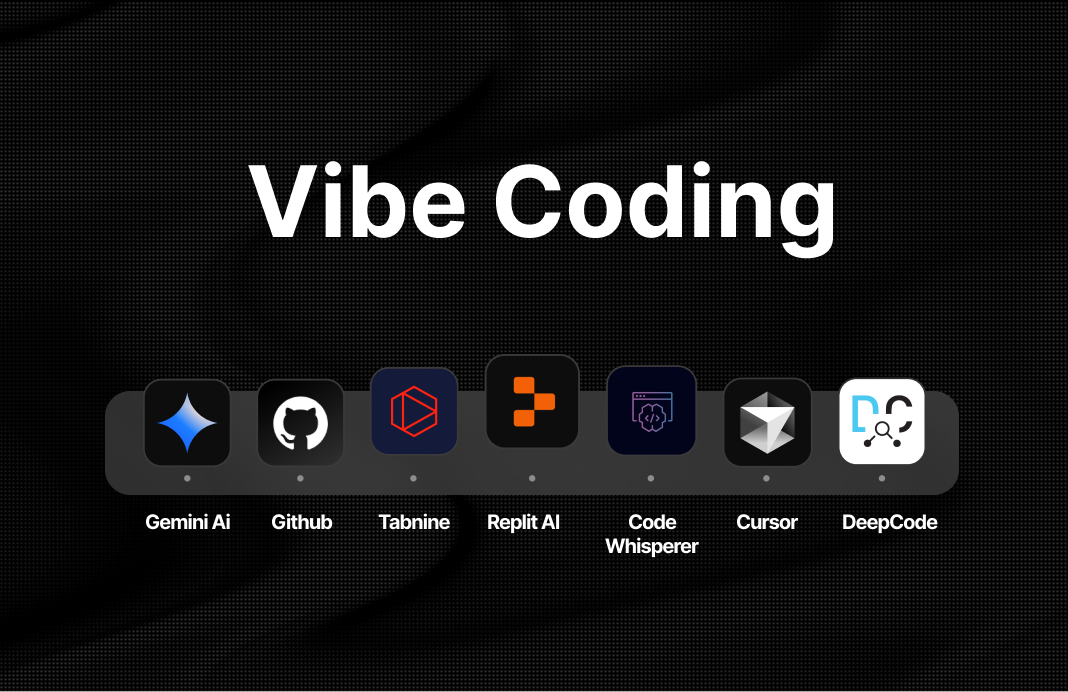
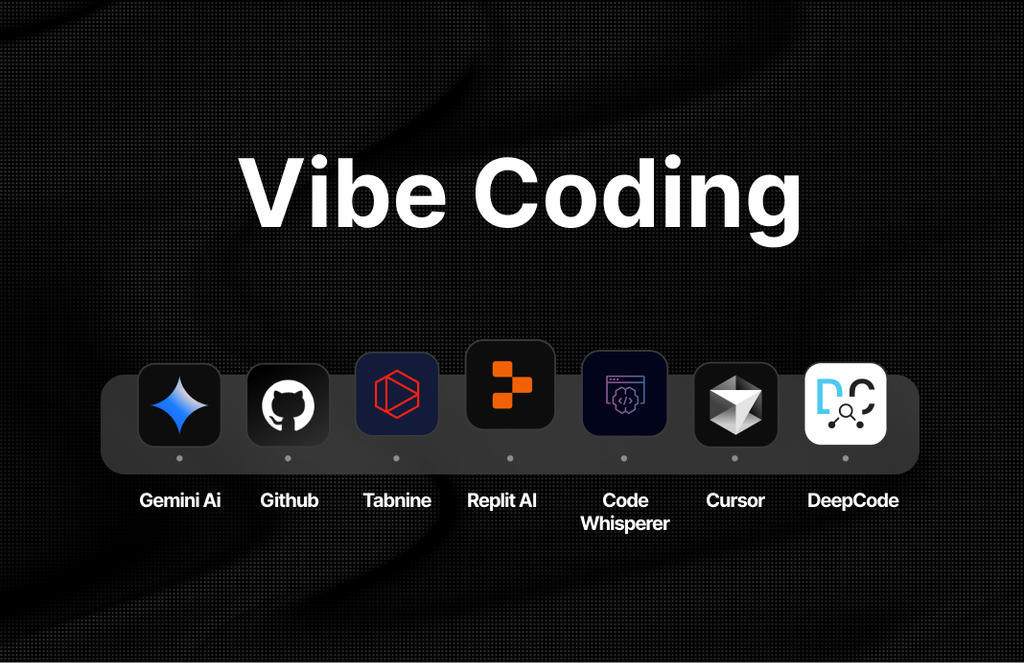
Most developers today use AI in some way. They may ask ChatGPT, Claude, Gemini, GitHub Copilot, Cursor or another tool to explain an error, generate a function, write tests or suggest improvements.
That does not automatically mean they are vibe coding.
Vibe coding goes further.
The person may describe an entire feature or even an entire application and allow the AI to generate large portions of the implementation.
The human increasingly becomes responsible for:
- describing the problem
- deciding what should be built
- reviewing the result
- testing the software
- identifying problems
- giving additional instructions
- making product decisions
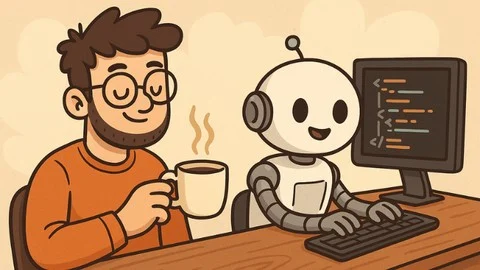
The keyboard is no longer necessarily the primary interface between the developer and the code.
The conversation can become the interface.
The Numbers Show That AI Coding Is Already Mainstream
This is not just a futuristic concept.
Stack Overflow’s 2025 Developer Survey collected responses from more than 49,000 developers across 177 countries. According to the survey, 84% of respondents were using or planning to use AI tools in their development process, compared with 76% the previous year.
That is a remarkable change.
But there is another number that I find even more interesting.
While AI adoption is increasing, trust is falling.
Stack Overflow reported that 46% of developers said they did not trust the accuracy of AI output, while only 33% trusted it. Only around 3% said they highly trusted AI-generated output.
This tells us something important:
Developers are using AI even though they know it can be wrong.
That is probably one of the most important realities of the current AI coding revolution.
The Biggest Advantage: Speed
The strongest argument for vibe coding is speed.
Imagine someone has an idea for a simple SaaS dashboard.
Without AI, they might need to:
- Design the interface.
- Set up the project.
- Create components.
- Write styles.
- Build APIs.
- Connect a database.
- Handle authentication.
- Test everything.
- Fix bugs.
With AI-assisted development, the first version can potentially be produced much faster.
This does not mean the final product will automatically be good.
It means the distance between “I have an idea” and “I have something I can interact with” becomes much shorter.
And I think that is where vibe coding is genuinely powerful.
It allows people to test ideas before investing huge amounts of time and money.
Vibe Coding Can Democratize Software Development
One of the most exciting aspects of this trend is accessibility.
A person who does not know React, Python, PHP or SQL may still be able to create a basic working application with AI.
That does not make them a software engineer overnight.
But it can make software development more accessible.
A small business owner could prototype an internal tool.
A student could create a project.
A designer could turn a prototype into an interactive website.
A startup founder could test an idea before hiring a development team.
According to Stack Overflow’s 2025 survey, more than 36% of respondents said they had spent time learning AI programming or AI-enabled tooling during the previous year, while AI-powered tools were among the popular ways people were learning about AI.
So AI is not simply generating code.
It is also becoming part of how people learn technology.
But Here Is the Problem: AI Can Produce Code That Looks Correct
This is where I become cautious about the idea of “anyone can code now.”
AI can produce beautiful interfaces.
It can generate hundreds of lines of code.
It can explain that code confidently.
And sometimes the code is still wrong.
One of the biggest frustrations reported in Stack Overflow’s 2025 survey was dealing with AI solutions that are “almost right, but not quite.” Around 66% of developers identified this as a frustration, while 45% said debugging AI-generated code can take more time.
This is a serious issue.
A beginner may see a working website and assume everything is fine.
But software can fail in places that are not immediately visible.
For example:
- security vulnerabilities
- poor database queries
- authentication problems
- data leaks
- scalability issues
- broken edge cases
- dependency problems
- performance issues
- incorrect business logic
A website that works on your laptop is not necessarily production-ready software.
The Productivity Question Is More Complicated Than It Looks
There is a popular assumption that AI automatically makes every developer faster.
But research suggests the reality is more complicated.
A 2025 randomized controlled trial conducted by METR looked at experienced open-source developers working on their own repositories with early-2025 AI tools.
Surprisingly, the researchers found that developers using AI took 19% longer on the studied tasks than those working without AI.
That sounds shocking when compared with the enormous productivity claims surrounding AI.
But it actually makes sense.
AI can generate code extremely quickly.
The problem is that humans still have to:
understand → verify → test → debug → integrate → maintain
If AI produces 1,000 lines of code in seconds but creates problems that take an hour to understand, the raw generation speed does not necessarily translate into productivity.
This is why I believe the future is not simply about writing code faster.
It is about making better decisions faster.
The Developer’s Job May Change — Not Disappear
I don’t think vibe coding means developers are going away.
I think it changes what valuable development skills look like.
In the past, knowing how to write code was a major part of the job.
In the AI-assisted future, developers may spend more time on:
- architecture
- system design
- security
- product thinking
- debugging
- testing
- reviewing AI-generated code
- understanding requirements
- managing complex systems
The ability to write code will still matter.
But the ability to understand code may become even more important.
If an AI gives you 500 lines of code and you cannot explain what those 500 lines are doing, you are not really in control of the software.
You are depending on the model.
And dependency is where the biggest risk begins.
Vibe Coding Has a “Black Box” Problem
Imagine asking AI to build an authentication system.
It generates the code.
The login works.
The registration works.
You are happy.
But what happens if:
- passwords are stored incorrectly?
- sessions are insecure?
- authorization is missing?
- an API endpoint exposes private data?
- a malicious user manipulates a request?
The interface may still look perfect.
This is why professional software development cannot simply become:
Prompt → Code → Deploy
There needs to be another stage:
Prompt → Code → Understand → Test → Secure → Deploy
That middle part is where experienced developers remain extremely valuable.
The Educational Debate
Vibe coding also creates a difficult question for students:
Should beginners learn programming if AI can write code for them?
My answer is yes.
Absolutely.
But perhaps we should change how programming is taught.
Students should not only memorize syntax.
They should understand:
- variables
- conditions
- loops
- functions
- data structures
- databases
- APIs
- authentication
- networking
- security
- debugging
- algorithms
- system architecture
Because these concepts allow a person to understand what AI is doing.
If you know nothing about programming, AI can become a magical box.
If you understand programming, AI becomes a powerful assistant.
That difference matters enormously.
Vibe Coding Is Excellent for Prototypes
Personally, I think vibe coding is particularly powerful in the early stages of a project.
For example, imagine a startup founder has an idea for a new application.
Instead of spending weeks debating whether the idea is worth building, they can use AI to create a prototype.
Then they can show it to potential users.
If nobody likes it, they have learned something without spending a huge amount of money.
If people love it, professional developers can then improve the architecture and turn the prototype into a reliable product.
This makes AI particularly valuable for experimentation.
Where I Would Not Blindly Trust Vibe Coding
There are situations where I would be much more careful.
For example:
Banking systems
Financial applications deal with highly sensitive information. Security and correctness are not optional.
Healthcare software
Errors can have serious consequences.
Large enterprise applications
Complex systems require architecture, documentation, testing and long-term maintenance.
Security-sensitive applications
Authentication, authorization, encryption and data protection require expert review.
Production infrastructure
A generated script that works once is not necessarily safe to run across an entire production environment.
In these areas, AI can still be extremely useful.
But AI should assist the expert rather than replace expertise.
The Rise of AI Coding Tools
The ecosystem is already changing rapidly.
Traditional environments such as Visual Studio and Visual Studio Code remain extremely popular, while AI-focused tools such as Cursor, Claude Code and Windsurf have also gained attention. Stack Overflow’s 2025 survey reported usage among respondents for these newer AI-enabled development tools.
The interesting thing is that we are moving beyond simple autocomplete.
Modern AI coding systems can increasingly:
- inspect project files
- understand multiple files
- generate features
- modify existing code
- run commands
- analyze errors
- write tests
- iterate on solutions
This moves AI from being a code suggestion tool toward becoming something closer to a development collaborator.
And that shift may ultimately be more important than the term “vibe coding” itself.
So, Is Vibe Coding the Future?
I think yes — but not in the way many people imagine.
I don’t believe the future is going to be a world where nobody learns programming and everyone simply tells AI what to build.
Instead, I see three groups developing.
1. Non-technical creators
They will use AI to build simple applications, websites and prototypes without becoming traditional programmers.
2. AI-assisted developers
They will understand programming and use AI to dramatically accelerate their workflow.
3. Highly skilled engineers
They will work on complex architecture, security, infrastructure and systems where deep technical knowledge remains essential.
The second group may become particularly powerful.
A developer who understands software engineering and also knows how to effectively use AI could potentially accomplish far more than a developer working entirely manually.
My Final Thought
Vibe coding is not the death of programming.
It is the beginning of a different relationship with programming.
For decades, we learned to translate our ideas into programming languages so that computers could understand us.
Now AI is increasingly becoming the translator between human language and software.
That is a huge change.
But I don’t think we should confuse the ability to generate code with the ability to engineer software.
AI can write the code.
AI can suggest the architecture.
AI can fix many bugs.
AI can even build surprisingly complex applications.
But someone still needs to ask:
Is this actually the right solution?
Is it secure?
Will it scale?
Can we maintain it?
What happens when it fails?
And perhaps most importantly:
Do we actually understand what we have built?
For me, that is the real lesson of vibe coding.
The future may not belong to people who can write the most code.
It may belong to people who can think clearly, communicate precisely, understand technology deeply, and use AI intelligently.
Vibe coding is therefore not necessarily replacing the programmer.
It is redefining what being a programmer can mean.
And that, in my opinion, is far more interesting than the idea of AI simply “taking coding away.”
— Iqra Aziz