
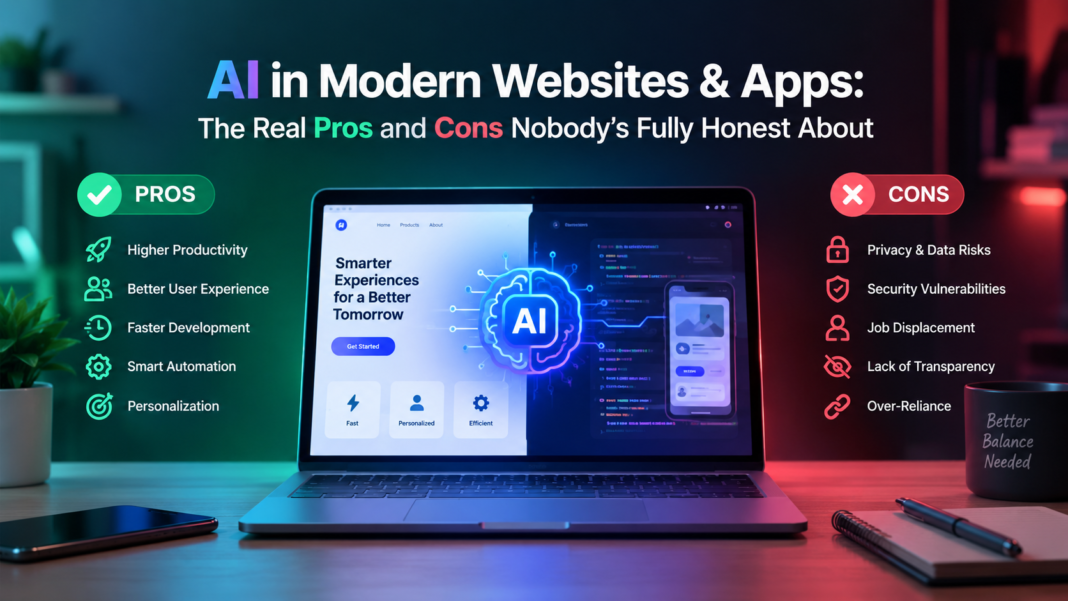


Open almost any app right now, and there’s a decent chance you’ll find an “AI-powered” badge somewhere on it — a chat assistant, a smart recommendation feed, an auto-generated summary, something. The label has become so common that it’s almost stopped meaning anything specific. One industry write-up put it bluntly: every app seems to be AI-powered in 2026, but some apps see dramatic gains in engagement and revenue from it, while plenty of others just bolted on a chatbot and called it innovation. AI is powerful, but it isn’t magical, and that gap between the marketing and the actual experience is exactly where this conversation gets interesting.
Why AI Spread Into Websites and Apps So Fast
This has genuinely been one of the fastest technology adoptions in recent memory, and it hasn’t just touched flashy new startups. Hosting platforms and content management systems now include AI by default, meaning AI integration has become a baseline expectation rather than a competitive edge. Think of it less as “adding a feature” and more like adding a smart assistant to an application — something that can analyze data, make predictions, understand user input, and even learn from interactions over time.
That shift matters because it’s changed what AI on a website or app actually does. It’s moved past being a gimmick for initial site creation or a one-off feature, and into ongoing, continuous work — handling routine tasks autonomously, from content updates to performance optimization, in the background, without someone manually triggering it each time.
The Real Pros
Faster, more responsive user experiences. According to research cited by McKinsey, AI genuinely benefits user experience and response times when implemented well — things like personalized recommendations, instant support answers, and smarter search that understands intent rather than requiring exact keywords.
Lower operational overhead for routine tasks. Because AI can manage recurring work like content updates and performance monitoring autonomously, teams spend less time on repetitive maintenance and more time on higher-value work.
Genuinely useful embedded features, when done right. The most successful real-world examples aren’t flashy standalone “AI chat everything” add-ons — they’re AI quietly embedded into existing workflows: smarter onboarding flows, AI copilots built directly into a product’s core tasks, and recommendation systems that actually reflect what a user does, not just what they clicked once.
Accessibility gains for non-technical users. AI-assisted tools, including voice-command website management features appearing in mobile ecosystems, are lowering the barrier for people without technical backgrounds to build, manage, or interact with digital products that previously required specialized skills.
The Real Cons (The Part Most Marketing Skips)
It’s not always faster — sometimes it’s slower, and that kills adoption. This is one of the more counterintuitive findings from current analysis: AI performance isn’t just about how “smart” a feature is, it’s about how it feels to use. A slower AI-powered experience often feels worse to a user than a faster non-AI alternative, and if AI hurts usability, it directly hurts adoption, no matter how impressive the underlying model is.
The “simple AI feature” is rarely simple to maintain. Many teams discover that what looked like a quick feature add-on becomes a long-term operational commitment — ongoing costs, monitoring, and upkeep that weren’t part of the original pitch. One architecture pattern commonly used for AI integration, API-based AI (plugging into services like OpenAI or Google Cloud), is fast to deploy, but comes with real downsides: ongoing API costs and vendor lock-in that teams have to plan around rather than treat as an afterthought.
A real skills gap is slowing things down. According to Hostinger’s AI statistics, 43% of business leaders cite a lack of AI expertise as their biggest implementation challenge — which is exactly why genuinely accessible, no-code interfaces matter more than raw model capability for a lot of businesses trying to adopt this responsibly.
Bias and data quality problems haven’t gone away. One persistent challenge heading into 2026 is ensuring training data is accurate, representative, complete, and free from bias, and this isn’t a hypothetical concern — it’s an active, ongoing issue that regulatory frameworks in the EU, the US, and other jurisdictions are now responding to directly, with bias audits and transparency requirements increasingly becoming mandatory rather than optional.
Privacy concerns are now a real adoption barrier, not a footnote. Users in 2026 are noticeably more sensitive about how their data is being used by AI features than they were even a couple of years ago. Apps that fail to clearly communicate what data is being collected and how it’s used tend to see real resistance and lower trust, regardless of how useful the underlying AI feature actually is.
Legacy system integration is still genuinely hard. Successful AI integration usually requires modernizing underlying infrastructure and building API layers that connect older systems with newer AI services — an incremental, often unglamorous process rather than a simple plug-and-play upgrade, even on flexible platforms like WordPress, where the plugin architecture and REST API help but don’t eliminate the planning work needed.
How to Tell If AI Actually Belongs in Your Product
The clearest, most honest filter from current industry thinking comes down to a simple question: does AI solve a real user problem, or is it there because it looks impressive on a feature list? For most products, AI should be treated as a feature, not the entire product — and in most cases, buying and integrating an existing model is the smarter business decision compared to trying to build proprietary AI from scratch, unless AI genuinely is your core product.
It’s also worth measuring success honestly. Vanity metrics, like how many users clicked on an AI feature once, don’t tell you whether it’s actually working. What matters more is whether the AI feature is being used repeatedly because it genuinely helps, not just because it was the shiny new button when the app updated.
My Honest Take
I think the most accurate way to describe where things stand right now is this: AI is not the future of apps and websites — smart AI implementation is. Those are very different things. Slapping a chatbot onto a product because competitors have one isn’t strategy, it’s anxiety dressed up as innovation. The products actually winning with AI right now aren’t the ones shouting “AI-powered” the loudest. They’re the ones who quietly figured out one specific, annoying problem their users had, and used AI to make that one thing noticeably better — without making the rest of the product slower, more confusing, or less trustworthy in the process. That’s a much smaller, much harder thing to do well, which is exactly why it’s rarer than the marketing around AI would have you believe.
FAQ
Is AI actually improving websites and apps, or is it mostly marketing?
Both are true simultaneously. Some products see genuine gains in user experience, engagement, and efficiency from AI, while many others add AI features mainly for marketing purposes without real functional benefit. The difference usually comes down to whether the AI solves a specific, real user problem.
What’s the biggest challenge businesses face when adding AI to their websites or apps?
According to industry data, 43% of business leaders cite a lack of AI expertise as their biggest implementation challenge, which is why accessible, no-code AI tools have become increasingly important for broader adoption.
Can AI make a website or app worse to use?
Yes. If an AI feature is slower than a non-AI alternative, it often feels worse to users, even if the AI itself is technically more “intelligent.” Poor implementation can directly reduce adoption rather than improve it.
Are there privacy concerns with AI features in apps?
Yes. Users have become more sensitive about data usage in AI-powered features, and apps that don’t clearly communicate what data is collected and how it’s used tend to face more resistance and lower trust.
Should every app or website have AI features?
Not necessarily. Industry analysis suggests AI should be treated as a feature that solves a specific problem, not an automatic requirement. For most businesses, integrating an existing AI model is more practical than building one from scratch, unless AI is the core product itself.
What are examples of AI integration that actually work well in 2026?
Examples cited include AI copilots embedded directly into existing workflows, smarter onboarding processes, and recommendation systems based on real user behavior, rather than standalone, generic “AI chat” features added without a clear purpose.
EXTERNAL SOURCES
- Hostinger — How AI Became Essential for Website Creation: Tools and Challenges for 2026
- Wbcom Designs — Top Challenges for Artificial Intelligence in 2026
- AppsOnAir — AI Integration for Apps: Hype vs. Reality in 2026
- Creatives On Call — How to Integrate AI in Website Applications: From Strategy to Implementation
- GitNexa — The Ultimate Guide to AI Integration in Web Applications