
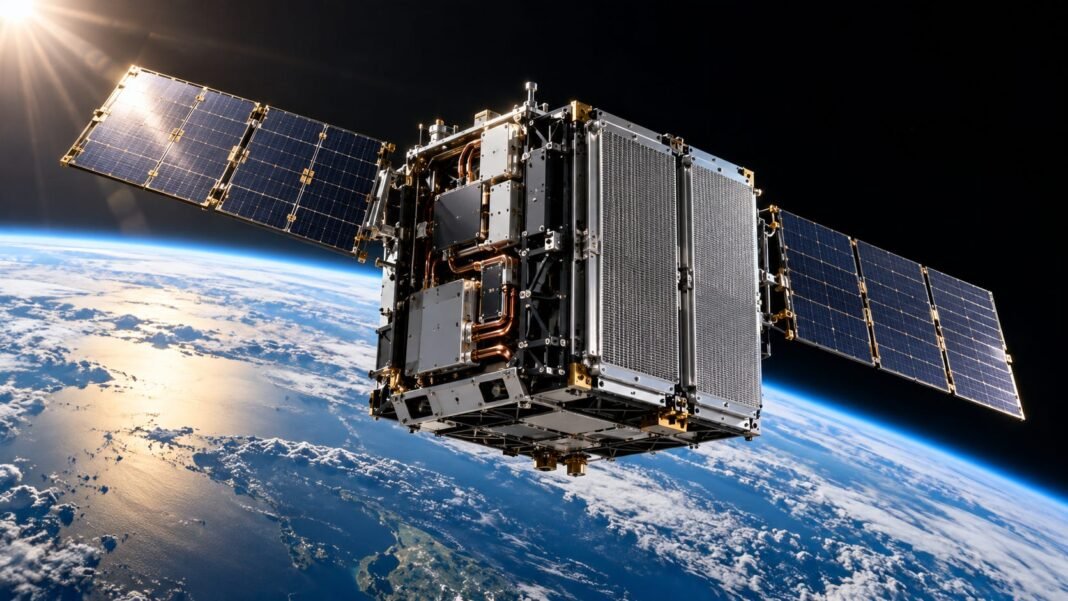


On October 1, 2026, Google did something that sounds like it belongs in a science fiction movie: it launched a refrigerator-sized satellite into orbit, carrying actual AI computer chips on board, as part of an effort called Project Suncatcher. The goal, stated plainly by Google itself, is to eventually build entire AI data centers that orbit the Earth instead of sitting in warehouses on the ground.
If your first reaction is “wait, why would anyone put a data center in space,” you’re not alone. It sounds unnecessarily complicated. But once you understand the actual problem Google is trying to solve, it starts to make a strange kind of sense.
The Real Problem: AI Needs an Enormous Amount of Power
Running AI models at scale takes a staggering amount of electricity. Some estimates suggest AI could account for close to 12% of national energy consumption by 2030 in some markets, and the biggest AI data centers being built today already pack in hundreds of thousands of chips, drawing up to a gigawatt of power each — several thousand times more than the entire International Space Station’s solar arrays produce.
That power has to come from somewhere, and on Earth, that increasingly means straining power grids, building new energy infrastructure, and sparking local fights over who foots the bill. In space, there’s a very different, very obvious power source available 24/7 in the right orbit: the sun, with no clouds, no atmosphere, and no nighttime to interrupt it.
What Project Suncatcher Actually Is
Project Suncatcher is Google’s research effort, developed together with the satellite company Planet, to test whether AI chips can actually survive and function in orbit well enough to make space-based data centers realistic. The prototype satellite launched this week carries four of Google’s own Tensor Processing Units, or TPUs — the same custom AI chips Google already uses in its terrestrial data centers to power products like Gemini.
This isn’t some fully operational space data center yet. Google’s own team has described it as “a very minimal test,” meant simply to confirm the chips can run at all once they’re off the planet. The test satellite will run a version of Google’s Gemma AI model in short bursts of about 15 minutes at a time, due to the heat the chips generate, before needing to shut down and cool off.
The bigger vision, though, is much more ambitious: clusters of many small satellites flying in tight formation, close enough to each other to communicate at high speed using lasers, working together as one distributed data center. Google has said it plans to launch two more satellites next year specifically to test how well satellites can stay connected to each other in orbit.
Why This Is Harder Than It Sounds
As promising as “free, constant sunlight” sounds, space brings a set of problems that don’t exist on Earth, and they’re not small ones.
Heat has nowhere to go. On Earth, data centers get cooled using air or water to carry heat away from the chips. In the vacuum of space, there’s no air and no water, which means heat generated by the chips has nowhere to escape except through large radiators built specifically to push it away — adding weight, complexity, and cost to every satellite.
Power needs are massive at small scale. A new Google research paper, published in the peer-reviewed journal Joule, found that data center satellites may need to produce as much power as a typical data rack on Earth, somewhere around 50 to 100 kilowatts, all generated and managed inside a single satellite.
There’s no technician to fix things. When something goes wrong in a data center on Earth, someone can physically walk in and repair it. In orbit, hundreds of miles above the planet, that’s simply not an option, which means these systems need to be far more fault-tolerant and self-sufficient than anything built for Earth.
Space is getting crowded. With thousands of satellites already in low Earth orbit and more being launched constantly, any future constellation of AI satellites will also need to be resilient against space debris and collision risks.
Google Isn’t Alone in This Race
This isn’t a one-company idea. A venture-backed startup called Starcloud already launched a spacecraft carrying an Nvidia H100 chip and demonstrated a version of Google’s own Gemini AI running from space. Elon Musk’s SpaceX is reportedly working on its own space data center ambitions too, with Musk previously stating he believes space is the “only way to scale” data centers to meet future AI demand, and the company has talked about deploying constellations of up to a million AI-computing satellites over time, with plans to begin deploying what it calls “orbital AI compute satellites” as early as 2028.
Experts remain genuinely split on how realistic the timeline is. A professor of electrical and computer engineering at Carnegie Mellon University described the overall concept as sounding “very sci-fi,” while acknowledging that much of the underlying technology has already been proven at a research level. Industry analysts have also pointed out that it’s currently very difficult to know when, or if, space-based data centers actually become economically viable compared to building more data centers on the ground — a lot depends on launch costs continuing to fall, with some estimates suggesting space-based compute could only approach cost parity with Earth-based data centers if launch prices drop below roughly $200 per kilogram sometime in the mid-2030s.
So Is This Actually Going to Happen?
Right now, the honest answer is: it’s a real, serious experiment, not a guaranteed future. Google has a genuine research paper behind this, a working test satellite in orbit, and a stated two-satellite follow-up planned for next year specifically to test inter-satellite communication — all of which suggests this is being taken seriously at the engineering level, not just floated as a marketing idea.
At the same time, the gap between “we successfully ran an AI model for 15 minutes on one test satellite” and “we operate a fully functional AI data center made of dozens of coordinated satellites in orbit” is enormous. Heat management, power generation at scale, satellite-to-satellite communication speed, and launch economics all still need to be solved, and none of them are small engineering problems.
What makes Project Suncatcher genuinely interesting isn’t that it’s guaranteed to work — it’s that one of the biggest AI companies in the world is treating “put the data center in space” as a serious enough idea to actually launch hardware and publish peer-reviewed research about it, rather than leaving it as a thought experiment. Whether or not this specific project ends up powering a chatbot you use someday, it’s a real signal of just how desperate the AI industry has become for a solution to its ever-growing appetite for electricity.
FAQ
What is Project Suncatcher?
Project Suncatcher is Google’s research initiative, developed with satellite company Planet, aimed at testing whether AI chips can function in space well enough to eventually build solar-powered AI data centers in orbit.
Did Google actually launch AI chips into space?
Yes. On October 1, 2026, Google launched a prototype satellite carrying four of its Tensor Processing Units (TPUs) into orbit as a first test of the concept.
Why does Google want to put AI data centers in space?
AI computing requires enormous amounts of electricity. In space, satellites can access near-constant sunlight without weather, clouds, or nighttime interruptions, offering a potentially more abundant power source than Earth-based infrastructure.
What are the biggest challenges facing space-based AI data centers?
Key challenges include managing heat with no air or water to dissipate it, generating enough power on a small satellite, maintaining high-speed communication between satellites, the inability to physically repair hardware in orbit, and the overall cost of launching and operating the systems.
Is Google the only company working on AI data centers in space?
No. A startup called Starcloud has already tested an Nvidia chip in orbit, and SpaceX has discussed plans to deploy its own “orbital AI compute satellites,” potentially as early as 2028.
When could space-based AI data centers actually become practical?
There’s no confirmed timeline. Some analysts suggest space-based compute could only become cost-competitive with Earth-based data centers if satellite launch costs fall below roughly $200 per kilogram, which some estimates place in the mid-2030s.
EXTERNAL SOURCES
- NPR — Google launches Project Suncatcher, a step towards AI data centers in space
- Scientific American — Google tests its plan for AI data centers in space with Project Suncatcher
- CNN — AI data centers in space? Google kicks off the race with a key test
- Data Center Dynamics — Project Suncatcher: Google to launch first space data center test in orbit
- TechRadar Pro — Google’s next moonshot wants to shoot AI data centers into space