
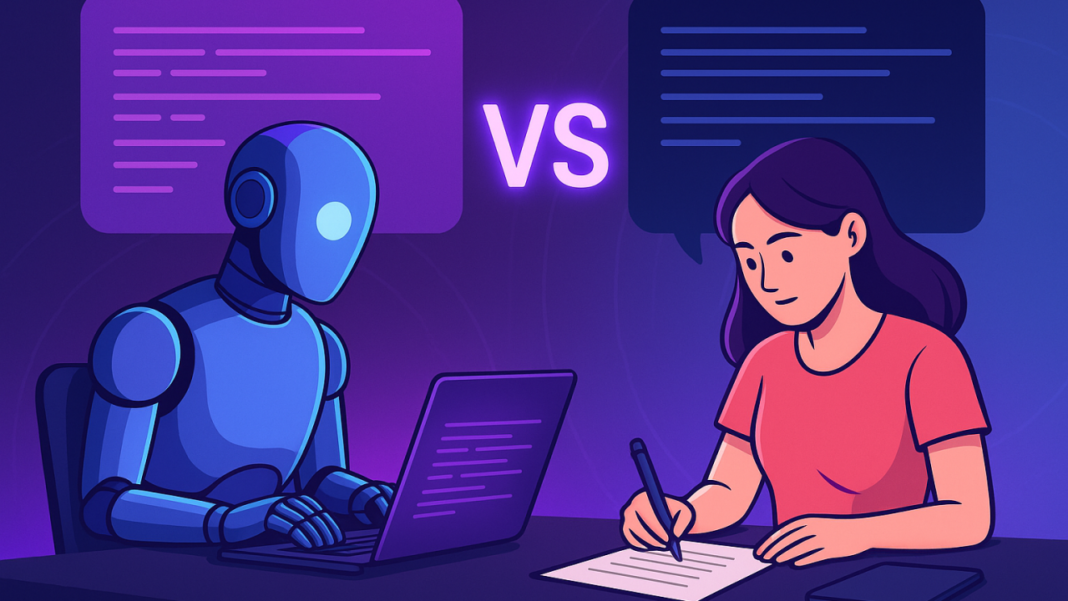

There is a question I keep seeing more often as AI coding tools become part of everyday software development:
If AI can write code in seconds, why do we still need developers?
It is a fair question.
A few years ago, writing software meant sitting down, understanding the problem, searching documentation, writing the code, testing it, finding bugs and then doing it all over again.
Today, I can describe what I want to an AI coding tool and get a working implementation in seconds.
So, has AI become better at coding than humans?
After looking at the available research and, more importantly, watching how developers are actually using these tools, I don’t think the answer is as simple as “AI is better.”
In some parts of programming, AI is clearly faster.
In other parts, I would still trust an experienced developer.
And there is an important difference between writing code and building software.
Let’s start with the part where AI really is better
I don’t think developers should pretend that AI has not changed programming.
It has.
A controlled study involving GitHub Copilot found that developers who had access to the AI pair programmer completed a particular JavaScript HTTP-server task 55.8% faster than the control group. The study was not saying that AI makes every developer 55.8% more productive in every situation, but it does provide real evidence that AI assistance can significantly speed up certain coding tasks.
And this makes sense from a developer’s point of view.
Suppose I need to write a repetitive API handler, create a basic React component, generate a database query or write a validation function.
Do I really want to spend 30 minutes writing boilerplate that an AI assistant can generate in a few seconds?
Probably not.
I’d rather use those 30 minutes somewhere else.
This is where AI is genuinely useful.
But then why don’t developers simply let AI write everything?
This is where the argument gets interesting.
If AI is so good at programming, you might expect developers to completely trust the generated code.
The data doesn’t show that.
Stack Overflow’s 2025 Developer Survey collected responses from more than 49,000 developers across 177 countries. According to the survey, 84% of respondents were using or planning to use AI tools in their development process, and 51% of professional developers said they use AI tools daily.
So yes, developers are using AI.
But here is the surprising part.
The same survey found that 46% of developers distrust the accuracy of AI output, compared with 33% who trust it. Only a small percentage reported highly trusting AI-generated output.
That tells us something important.
Developers are not rejecting AI.
They are using it while still being skeptical about what it produces.
And honestly, I think that is the correct attitude.
“But AI can write code faster than me.”
Yes.
It can.
But that doesn’t automatically mean it can replace you.
Imagine that I ask an AI:
Build an authentication system for my application.
It can generate the login page.
It can create API routes.
It can write password validation.
It can create database queries.
It can even suggest authentication middleware.
But there are questions that come before the code:
Should the application use sessions or tokens?
Where should credentials be stored?
What permissions should different users have?
What happens when a user’s account is compromised?
Which routes should be publicly accessible?
What information should the API return?
How should the system behave when the database is unavailable?
These aren’t simply “write some code” questions.
They are software engineering decisions.
And this is where I think the human developer still has an important role.
AI knows a lot of code. It doesn’t automatically know your product.
This is another distinction that is easy to miss.
An AI model may know thousands of programming patterns.
But your application has its own requirements.
A real project might have a particular database structure, existing APIs, business rules, security requirements, customer expectations and technical limitations.
The developer has to understand all of that.
The AI can help write the implementation.
But somebody still has to decide what the implementation should actually do.
That is one reason Stack Overflow’s survey found that developers are much less comfortable handing AI high-responsibility tasks.
For example, 76% said they don’t plan to use AI for deployment and monitoring, while 69% said they don’t plan to use AI for project planning.
That distinction is important.
Developers are happy to ask AI to help write code.
They are much more cautious about letting AI make decisions that can have serious consequences.
The “almost correct” problem
There is another problem that every developer who regularly uses AI eventually encounters.
The code looks right.
It runs.
And then something goes wrong.
Stack Overflow’s 2025 survey found that 66% of developers were frustrated by AI solutions that were “almost right, but not quite.” Another 45% said debugging AI-generated code can be more time-consuming.
This is something I think people outside software development sometimes underestimate.
Bad code isn’t always code that immediately crashes.
Sometimes the dangerous code is the code that works most of the time.
It might fail only with a particular input.
It might create a security vulnerability.
It might work with 100 users but become inefficient with 100,000.
It might use a deprecated library function.
It might solve the immediate problem while making the rest of the project harder to maintain.
That is why a developer can’t simply ask an AI for code, paste it into production and walk away.
Someone has to review it.
So, is AI actually making developers faster?
The answer appears to be yes for many developers, but there is an important qualification.
Stack Overflow reported that 52% of developers said AI tools or agents had a positive effect on their productivity in 2025. Among developers using AI agents, 69% agreed that the agents had increased their productivity.
But productivity isn’t the same thing as quality.
Writing 1,000 lines of code instead of 500 doesn’t automatically mean the software is twice as good.
Sometimes the fastest solution is not the best solution.
This is one reason I don’t measure a developer’s ability simply by how quickly they can produce code.
I would rather ask:
Can they understand the problem?
Can they design the system?
Can they find the bug?
Can they explain their decisions?
Can they maintain the project six months later?
Those questions are much harder than “Can you generate a React component?”
What happens to junior developers?
This is probably the most uncomfortable part of the discussion.
If AI can generate basic code, what happens to someone who is just starting to learn programming?
I don’t think the answer should be “don’t learn programming anymore.”
I think it should be the opposite.
Learn programming.
Learn how the web works.
Learn databases.
Learn APIs.
Learn debugging.
Learn security.
Learn how to read documentation.
Then use AI.
Why?
Because if you don’t understand programming, you have a much harder time recognizing when AI is wrong.
You may get a beautiful-looking answer and assume it is correct simply because you don’t know enough to challenge it.
Stack Overflow’s survey actually found that 61.3% of respondents said they want to fully understand the code they are working with, while 75.3% said they would ask another person for help when they don’t trust AI’s answers.
That says a lot.
AI may reduce the amount of code we have to type.
It doesn’t remove the need to understand what that code is doing.
Then who wins: AI or humans?
If the question is:
“Who can generate code faster?”
AI has a very strong advantage.
If the question is:
“Who can produce a useful software product without human supervision?”
The answer is much less obvious.
Software development isn’t just typing syntax.
A developer has to deal with incomplete requirements, changing business needs, users, security, performance, architecture, maintenance and unexpected problems.
AI can assist with many of these things.
But assistance and responsibility are not the same thing.
My view as a developer
I don’t see AI as the enemy of developers.
I actually use the opposite way of thinking.
If AI can remove repetitive work from my day, that’s a good thing.
If it can explain an unfamiliar API, help me debug something, generate a first version of a component or help me explore an approach, I’m going to use it.
But I don’t want AI to replace my understanding of the project.
For me, the ideal workflow is not:
Human OR AI
It is:
Human + AI.
The human decides what needs to be built.
AI helps explore and implement possible solutions.
The human reviews the result.
Tests are written.
The code is improved.
And finally, the developer remains responsible for what goes into production.
I think that is a much more realistic picture of where software development is going.
The real competition may not be “AI vs developers”
There is one more question I would ask.
If AI becomes better and better at writing code, who will have the advantage?
The developer who refuses to use AI?
Or the developer who understands programming and knows how to use AI effectively?
For me, the answer is pretty clear.
The second developer has the advantage.
AI is already becoming part of normal development workflows. The 2025 Stack Overflow survey shows that adoption is widespread, while trust remains a major issue.
So I don’t think the future belongs to developers who write every line manually.
And I don’t think it belongs to people who blindly tell AI what to build and copy whatever comes back.
It will probably belong to developers who can do both:
understand the technology and use AI intelligently.
Final answer: Is AI better than humans at coding?
At generating code quickly? Often yes.
At understanding context? Not always.
At repetitive programming? AI can be extremely effective.
At making responsible engineering decisions? Humans still matter enormously.
At building software with AI as a partner? That’s where things get really interesting.
So, if someone asks me today whether AI will replace developers, my answer isn’t simply “no.”
My answer is:
AI will replace some of the work developers currently do.
And that’s already happening.
But replacing parts of a developer’s workflow is very different from replacing the developer who understands the problem, checks the result and takes responsibility for the final software.
That distinction may become one of the most important ideas in programming over the next few years.