
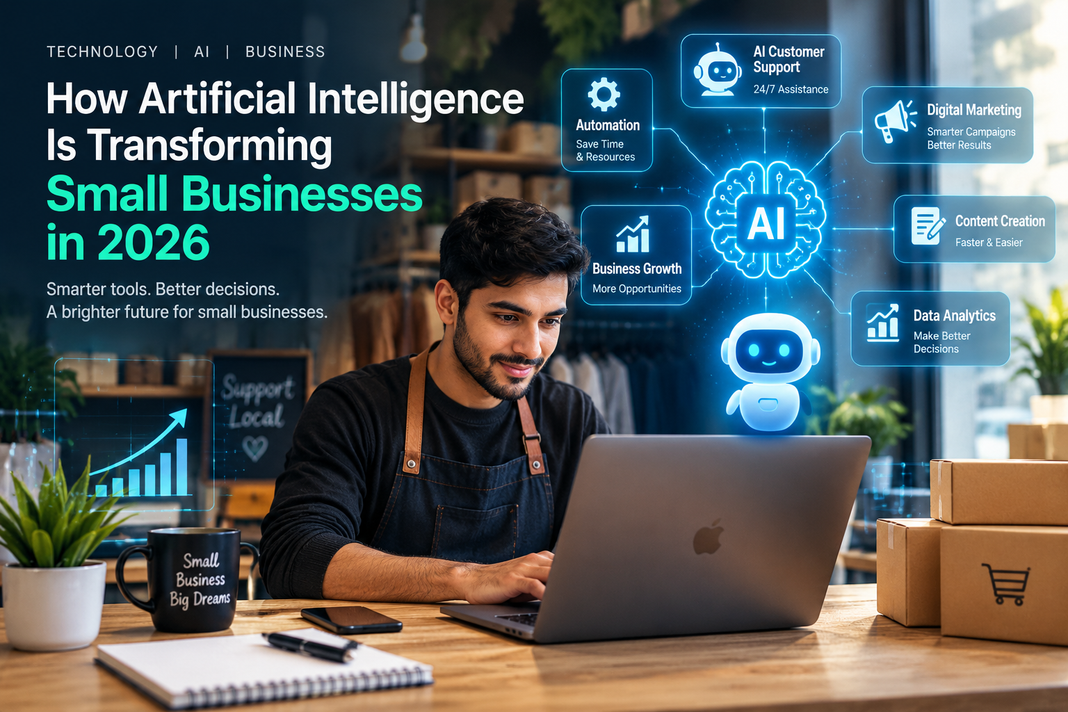


Artificial Intelligence is no longer a technology reserved for large corporations with massive budgets. In 2026, small businesses are increasingly using AI to automate repetitive tasks, improve customer experiences, create content, analyze data, and make better business decisions.
From small online stores to digital agencies and local businesses, AI-powered tools are changing the way companies operate. Businesses that once needed large teams to manage marketing, customer support, data analysis, and content creation can now use AI tools to complete many of these tasks faster and more efficiently.
The growing availability of affordable AI platforms has created new opportunities for entrepreneurs and small business owners around the world.
AI Is Making Business Operations More Efficient
One of the biggest advantages of Artificial Intelligence is automation.
Small businesses often operate with limited staff and resources. Employees may need to manage multiple responsibilities, including customer support, marketing, social media, sales, and administration.
AI can help automate many repetitive tasks.
For example, businesses can use AI-powered systems to:
- Respond to common customer questions
- Organize and analyze business data
- Generate reports
- Create marketing content
- Schedule social media posts
- Write product descriptions
- Summarize documents
- Assist with email communication
Automation allows employees and business owners to spend more time on important activities such as strategy, customer relationships, and business growth.
Instead of replacing every employee, AI is increasingly being used as a productivity tool that helps teams complete work more efficiently.
AI-Powered Customer Support Is Becoming More Common
Customer support has traditionally required businesses to hire employees who can answer customer questions through email, phone calls, and live chat.
AI is changing this process.
Modern AI chatbots can answer frequently asked questions, provide information about products and services, guide customers through websites, and assist with basic support requests.
This can be especially useful for small businesses that operate online and receive customer inquiries outside normal working hours.
An AI-powered customer support system can potentially provide assistance 24 hours a day while allowing human employees to handle more complex issues.
However, businesses still need human support teams. AI systems may misunderstand questions or provide inaccurate responses, especially when dealing with complex situations.
The most effective approach for many businesses is a combination of AI automation and human customer support.
AI Is Changing Digital Marketing
Digital marketing is one of the areas most affected by Artificial Intelligence.
Small businesses can now use AI tools to generate ideas for blog posts, social media campaigns, advertising copy, email campaigns, and product descriptions.
AI can also help marketers analyze customer behavior and identify trends.
For example, businesses may use AI to understand:
- Which products customers are interested in
- Which marketing campaigns perform better
- When customers are most active
- Which type of content receives more engagement
- Which audience may be interested in a specific product
This allows businesses to make more data-driven marketing decisions.
However, AI-generated marketing content should not simply be copied and published without human review.
Successful businesses will continue to use human creativity, brand knowledge, and industry expertise to create content that feels authentic and useful.
AI should be viewed as an assistant rather than a complete replacement for human marketers.
Content Creation Is Becoming Faster
Creating high-quality content can require significant time and resources.
Businesses need blog posts, social media content, videos, product descriptions, newsletters, advertisements, and website content.
AI-powered tools can help businesses create initial drafts, generate ideas, summarize information, and improve existing content.
This is particularly useful for small businesses that do not have dedicated content teams.
For example, a small technology company could use AI to brainstorm article ideas, create a first draft, and organize research. A human editor can then review the content, verify information, add expertise, and ensure that the final article matches the company’s brand.
This combination can significantly reduce the time required to produce content.
However, quality remains important.
Businesses that publish large amounts of low-quality or inaccurate AI-generated content may damage their reputation. Human editing, fact-checking, and original insights remain essential.
AI Is Helping Businesses Understand Data
Many small businesses collect valuable data but struggle to understand how to use it.
Sales reports, website analytics, customer feedback, and marketing statistics can contain useful information.
AI-powered analytics tools can help businesses identify patterns and trends within this data.
For example, a business may discover that a particular product performs better during certain months or that customers from a specific location are more likely to purchase a particular service.
These insights can help businesses improve their marketing strategies and make better decisions.
Previously, advanced data analysis was often limited to large companies that could afford specialized teams.
AI tools are making data analysis more accessible to smaller organizations.
AI Is Creating New Opportunities for Entrepreneurs
Artificial Intelligence is not only changing existing businesses. It is also creating completely new business opportunities.
Entrepreneurs are launching businesses around AI-powered products and services.
Some examples include:
- AI software platforms
- AI content services
- AI automation agencies
- AI-powered customer support services
- AI design tools
- AI data analysis platforms
- AI marketing tools
- AI education platforms
Developers are also building applications that integrate AI features into existing products.
For example, a website builder may add an AI content generator. A CRM platform may introduce AI-powered customer insights. An e-commerce platform may add AI product recommendations.
As AI technology becomes easier to access through APIs and cloud services, more developers and startups are expected to build specialized AI solutions.
The Importance of Responsible AI
While AI offers many opportunities, businesses must also consider potential risks.
AI systems can produce inaccurate information. They may also create biased or misleading results.
Businesses should avoid relying completely on AI-generated information without verification.
Privacy is another important concern.
Companies that use customer data with AI systems should understand how that data is processed and protected.
Businesses should also be transparent when AI systems interact directly with customers.
Responsible use of AI can help companies build trust while reducing potential risks.
AI Will Not Replace Every Business Professional
There is significant discussion about whether AI will replace human workers.
While AI is capable of automating certain tasks, many areas of business still require human skills.
Creativity, leadership, negotiation, relationship building, strategic thinking, and emotional understanding remain valuable.
Instead of replacing every worker, AI is likely to change the type of work people perform.
Employees may spend less time on repetitive tasks and more time on work that requires creativity and decision-making.
Businesses that invest in training their teams to use AI effectively may gain a competitive advantage.
What Small Businesses Should Do Next
Small businesses do not need to completely transform their operations overnight.
A better approach is to identify tasks that consume significant time and explore whether AI can assist.
Businesses can start by asking questions such as:
- Which repetitive tasks take the most time?
- Can customer support be partially automated?
- Can AI help analyze business data?
- Can content creation become more efficient?
- Which AI tools can integrate with existing systems?
Starting with small experiments can help businesses understand where AI provides real value.
It is also important to measure results.
If an AI tool saves time, improves customer satisfaction, or increases productivity, it may be worth expanding its use.
The Future of AI and Small Businesses
Artificial Intelligence is expected to become an increasingly important part of the global business environment.
The companies that benefit most may not necessarily be those that use the largest number of AI tools.
Instead, successful businesses will be those that identify practical ways to use AI to solve real problems.
For small businesses, AI provides an opportunity to compete more effectively with larger companies.
Automation can reduce repetitive work. AI-powered analytics can improve decision-making. Content tools can help teams create marketing materials faster. Customer support systems can provide assistance outside normal working hours.
The future of business is unlikely to be completely automated.
Instead, it will likely involve a combination of human creativity and artificial intelligence.
Businesses that learn how to combine these two strengths effectively may be better positioned to grow in the increasingly competitive digital economy.
Final Thoughts
Artificial Intelligence is rapidly becoming an important tool for businesses of all sizes.
For small businesses, the biggest opportunity is not simply using AI because it is popular. The real value comes from using AI strategically to improve productivity, customer experiences, marketing, and decision-making.
As AI technology continues to evolve, entrepreneurs and business owners will have access to more powerful tools than ever before.
The businesses that adapt, experiment, and use these technologies responsibly may gain a significant advantage in the years ahead.