
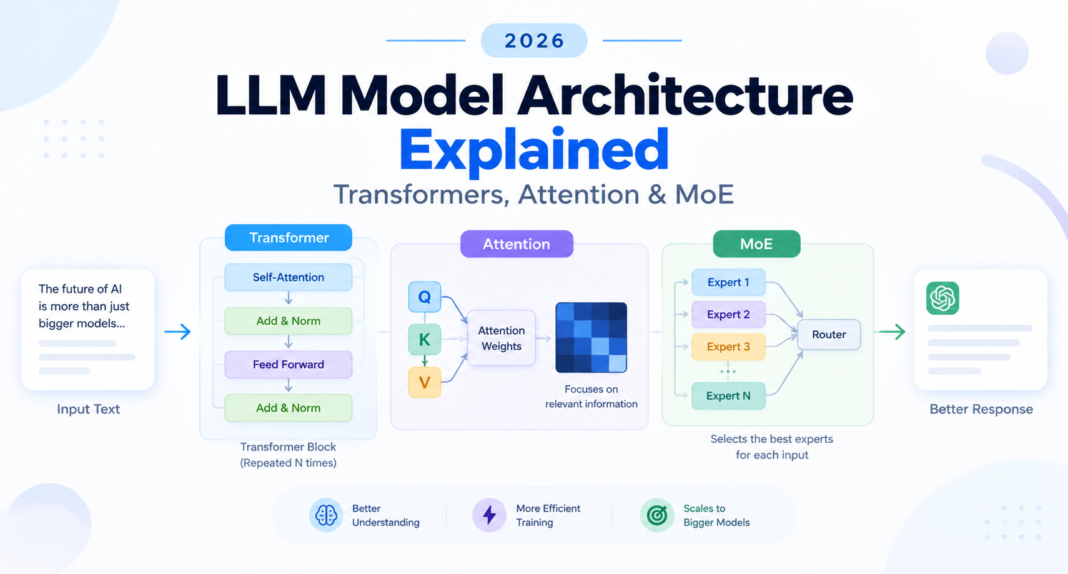


Every time someone types a question into ChatGPT, Claude, or Gemini, there’s this assumption that something incredibly mysterious is happening behind the scenes. And in a way, it is — but not in the way most people imagine. There’s no hidden database of pre-written answers, and it’s not “looking things up” the way a search engine does. What’s actually happening is a fairly well-understood, well-documented architecture doing math, at an enormous scale, based on patterns it learned during training. Let’s actually walk through what that architecture looks like, because once you see the pieces, the “magic” starts to make a lot more sense.
It All Starts With the Transformer
Almost every large language model in use today — regardless of who built it — is based on something called the transformer architecture, first introduced by Google researchers back in 2017. Before transformers, language models relied on recurrent neural networks, which processed text one word at a time, in order, which made them slow and genuinely bad at remembering things that were said many sentences earlier. Transformers threw that approach out entirely and replaced it with something called self-attention.
Self-attention lets the model look at every word in a sentence (or paragraph, or document) at the same time, and figure out how much each word should “pay attention to” every other word. This is how a model figures out that in the sentence “the dog chased the ball because it was excited,” the word “it” refers to the dog, not the ball. The model isn’t reading left to right like a person — it’s weighing relationships across the entire input simultaneously.
The Core Building Blocks Inside Every Transformer Layer
Inside a transformer, text first gets broken into small pieces called tokens — sometimes whole words, sometimes just parts of words. Each token gets converted into a list of numbers (a vector) that represents its meaning in a mathematical space. From there, the model runs these tokens through repeated layers, and each layer typically does two main things: it runs the tokens through the self-attention mechanism described above, and then passes the result through what’s called a feed-forward network — a simpler layer that processes each token individually and adds more depth to what the model has learned about it.
Stack enough of these layers on top of each other — modern frontier models can have dozens of them — and the model builds an increasingly rich understanding of context, meaning, grammar, and even reasoning-like patterns, purely from how it was trained on enormous amounts of text.
The Problem That Started Changing Everything: Scale
For years, the dominant strategy for making LLMs smarter was simple: make them bigger. More parameters (the internal numerical values a model adjusts during training), more layers, more data. And it worked — bigger models generally performed better. But it came with an obvious catch: a dense model, where every single parameter gets used for every single word you type, gets extremely expensive to run as it grows. A 70-billion-parameter dense model uses all 70 billion parameters just to process one token, every single time.
That cost problem is exactly what led to the architecture shift that’s now defined nearly every major model release in 2026.
Mixture of Experts: The Architecture Powering Nearly Every Major Model Right Now
Mixture of Experts, usually shortened to MoE, is a design where instead of one giant feed-forward network handling every token, a model has many smaller “expert” networks — sometimes 8, sometimes over 100 — sitting inside each layer. A small, trainable component called a router (or gating network) looks at each incoming token and decides which one or two experts are best suited to handle it. The rest of the experts simply sit idle for that token.
This means a model can have an enormous total parameter count while only activating a small fraction of those parameters for any single word being processed — giving you the knowledge capacity of a massive model at something closer to the computational cost of a much smaller one. DeepSeek-V3 is a well-known example of this in action: it has roughly 671 billion total parameters, but only around 37 billion are actually active for any given token. By 2026, this sparse-activation approach has become the default scaling strategy across nearly every serious open-weight model release, including names like DeepSeek, Llama 4, Mixtral, and Qwen.
It’s worth clearing up a common misconception here, though: the “experts” in Mixture of Experts aren’t specialized in the way a human expert is. Nobody trains one expert specifically on math and another specifically on poetry. Instead, each expert network gradually specializes on its own during training, picking up patterns based on whatever types of tokens the router happens to send its way — it might lean toward grammar patterns, or factual recall, or code-like structures, but this specialization emerges naturally rather than being explicitly assigned.
Why Attention Gets Expensive, and What Fixes That
There’s a mathematical quirk in the original transformer design that’s worth understanding, because it explains a lot of the engineering work happening behind the scenes in modern models. Self-attention compares every token to every other token, which means the computational cost grows quadratically with the length of the text — double the input length, and the attention computation roughly quadruples. This is exactly why very long documents or conversations used to be so computationally expensive to process.
This is where techniques like FlashAttention (a more memory-efficient way of computing attention without changing its output) and Grouped-Query Attention (which reduces redundant computation across attention “heads”) come in. These optimizations, combined with MoE, are a big part of why context windows — the amount of text a model can consider at once — have grown from a few thousand tokens just a few years ago to several hundred thousand tokens in many of today’s leading models.
Retrieval-Augmented Generation: Giving Models Access to Fresh Information
One limitation baked into this entire architecture is that everything a model “knows” comes from its training data, frozen at whatever point training stopped. That’s where retrieval-augmented generation, or RAG, comes in — it’s not part of the core model architecture itself, but it’s become a standard companion technique. Instead of relying purely on what the model memorized during training, RAG systems search an external source (a database, a set of documents, the live web) for relevant information and feed it into the model alongside the user’s question, letting the model generate an answer grounded in current, specific information it was never actually trained on.
Putting It All Together
So when you send a message to a modern AI model, here’s roughly what’s happening: your text gets broken into tokens, those tokens get converted into numerical vectors, and they pass through dozens of transformer layers where self-attention figures out how every word relates to every other word. In most frontier models today, when those tokens hit the feed-forward portion of each layer, a router decides which handful of expert sub-networks should process them, keeping computation manageable even though the model’s total knowledge capacity is enormous. Optimizations like FlashAttention keep long conversations computationally feasible, and in many production systems, retrieval mechanisms pull in outside information to keep answers current. None of it is magic — it’s a genuinely elegant piece of engineering, refined over roughly a decade of research, that happens to produce results that feel like magic when you’re on the other end of it.
FAQ
What is the basic architecture behind most LLMs?
Nearly all large language models are built on the transformer architecture, which uses a mechanism called self-attention to understand relationships between words across an entire piece of text at once, rather than processing it word by word in order.
What is Mixture of Experts (MoE) in LLMs?
MoE is an architecture where a model’s feed-forward layers are replaced with multiple smaller “expert” networks. A router selects only a few relevant experts to process each token, allowing models to have enormous total parameter counts while keeping the actual computation per token much smaller.
Why did AI models shift toward Mixture of Experts?
Dense models require activating every parameter for every single input, which becomes extremely expensive as models grow larger. MoE lets models scale up their total knowledge capacity without a proportional increase in computational cost per token.
Are all modern LLMs transformer-based?
Effectively yes, as of 2026. Alternative approaches like state-space models (Mamba-style architectures) exist and are sometimes combined with transformer elements, but they haven’t replaced transformers for general-purpose language modeling.
What is retrieval-augmented generation (RAG)?
RAG is a technique where a model retrieves relevant information from an external source, such as a document database or the web, and uses that information alongside its own training to generate a more accurate, up-to-date answer.
Why is long-context processing computationally expensive?
Because self-attention compares every token in the input to every other token, the computational cost grows quadratically as input length increases, which is why techniques like FlashAttention and Grouped-Query Attention have become important for handling long documents and conversations efficiently.
EXTERNAL SOURCES
- Clarifai — LLM Model Architecture Explained
- DEV Community — Mixture of Experts (MoE) Explained: How Sparse Architecture Powers Llama 4, Mixtral, and Modern LLMs
- Labellerr — 7 Top Mixture of Experts AI Models for Developers in 2026
- AI Weekly — What Is Mixture of Experts (MoE)? How Modern LLMs Get Efficient
- AI Agent Rank — Transformer Architecture Glossary Entry