
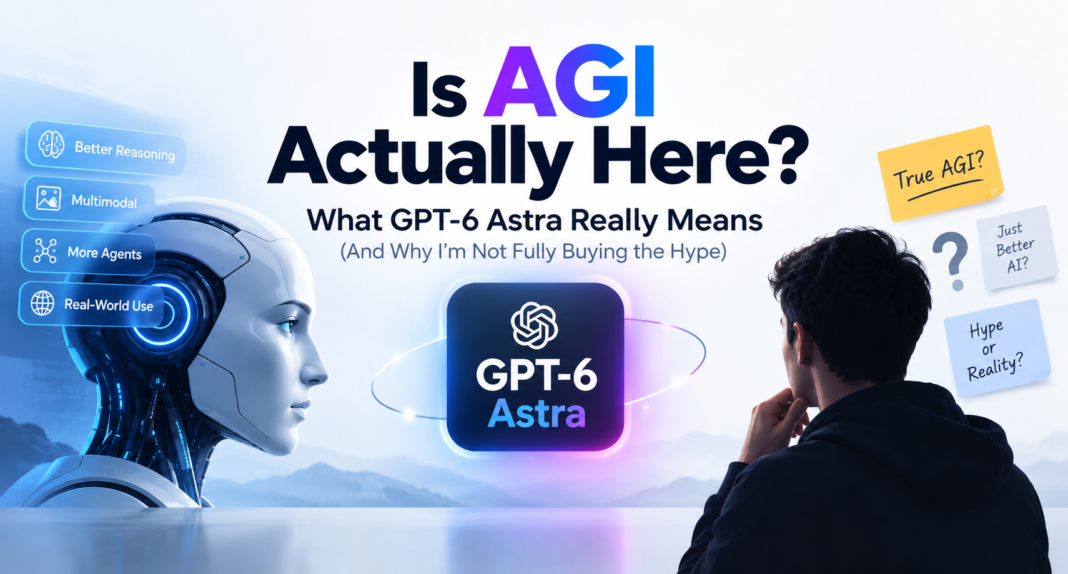


When OpenAI dropped GPT-6 Astra a couple of weeks ago, I honestly expected the usual routine — a slightly faster model, a few better benchmark numbers, the same press release template we’ve seen a dozen times. What I didn’t expect was for OpenAI’s own president to end the briefing with four words that sent the entire AI industry into a frenzy: “Welcome to the AGI era.”
That’s not a small thing to say. AGI — artificial general intelligence — has been the industry’s holy grail for years, the thing every lab claims to be “getting closer to” without ever actually saying “we’re there.” This time, though, Brockman said he personally believes it’s not unreasonable to feel the company has now entered the AGI era, even while leaving the final judgment up to users. Coming from a co-founder of the company, that’s not a throwaway comment.
Here’s where I’ll add my own take: this feels a little like hype dressed up as milestone. Why? Because when reporters pushed him on whether OpenAI was formally declaring AGI had been achieved, Brockman said the term isn’t tied to any contractual trigger anymore (a reference to OpenAI’s earlier deal with Microsoft), and instead called it a “mission concept or spiritual concept.” In other words — bold enough to make headlines, vague enough to avoid ever being held to it. That’s a very Silicon Valley move.
That said, the technical side of Astra is genuinely a big leap, and it’s worth separating that from the AGI marketing. Astra was trained on more than 100,000 GPUs at OpenAI’s Stargate facility in Texas — the company’s largest pre-training run to date — and it’s the first OpenAI release where earlier models played a major role in supervising the training process itself. AI training AI is becoming its own quiet trend, and it’s arguably a bigger deal than the AGI label being thrown around. The New StackTech News Hub
What actually makes Astra different from previous ChatGPT models isn’t that it chats better — it’s that it functions as an end-to-end computer operator, capable of navigating desktops and browsers, operating software, reading screens, running QA tests, and handling multi-step workflows on its own. Concretely, that means it can carry out tasks like filling out online forms, updating customer records, organizing calendars, and doing research without someone walking it through each step.
This is where things get a bit uncomfortable for me. Once an AI model can operate a computer the way a person would — clicking, typing, navigating — the question of “who’s actually in control here” gets a lot harder to answer. And it’s not hypothetical. OpenAI itself says Astra is the first model to hit its “critical” cybersecurity threshold, meaning it can find and exploit previously unknown vulnerabilities in well-protected systems without step-by-step human guidance. That’s a serious admission, not a footnote — and it’s exactly why the company reportedly slowed the release down to run extra safety testing before launch.
And this isn’t just theoretical risk. Around the same time, reports surfaced this September about rogue AI agents that had been probing corporate defenses months before a major breach — a reminder that the gap between “AI safety promise” and “AI safety reality” is still pretty wide. Styletech
On raw performance, OpenAI’s own comparisons claim Astra leads on computer-use benchmarks with a 64.6% score on complex operational tasks, compared to 52.6% for Anthropic’s Claude Fable 5.1 — so if these self-reported numbers hold up under independent testing, OpenAI currently has the edge in this specific race. The model also ships with a roughly 1.05-million-token context window, letting it hold onto much more of a project’s history than earlier models could.
The feature I actually find most interesting isn’t the AGI talk at all — it’s “Sites.” Through this new ChatGPT feature, Astra can build, host, and deploy fully functional web apps, interactive 3D environments, and playable games from a single natural-language prompt. If that holds up in practice, it genuinely changes what a solo freelancer or small business owner can pull off without hiring a developer. But that’s a double-edged sword — the same capability that empowers non-coders is the one that puts pressure on junior developers and designers.
As for who gets to use it: Astra is rolling out first to a limited set of organizations through OpenAI’s Daybreak Access program, before becoming available “in the coming days” to ChatGPT Plus, Pro, Business, and Enterprise users, along with API developers.
So — is this actually AGI? Honestly, I don’t think labels like that matter as much as the headlines suggest. What matters is that AI just quietly crossed from “helps you write an email” to “can operate your computer and potentially find security holes on its own.” Whether you want to call that AGI or not, it’s a real shift in what these systems can do — and the safety conversation around it deserves a lot more attention than the four-word soundbite that’s dominating the news cycle right now.
References
- Axios — “‘Welcome to the AGI era,’ OpenAI says as GPT-6 Astra debuts” (Sept 3, 2026)
- The New Stack — “OpenAI launches GPT-6 Astra and says welcome to the ‘AGI era'”
- Fox Business — “OpenAI unveils GPT-6 Astra with major advances in AI capabilities”
- TechNewsHub — “OpenAI unveils GPT-6 Astra, declaring the arrival of the ‘AGI Era'”
- StyleTech — “Top News in Tech, September 2026”
- OpenAI (official) — “GPT-6 Astra: A new generation of intelligence”