Real-Time Data Streaming with Apache Kafka and Beyond
Apache Kafka remains the backbone of real-time data streaming, while emerging alternatives and complementary technologies expand the streaming ecosystem.
Introduction
Real-time data streaming has become an essential architectural pattern for organizations that need to process, analyze, and act on data as it is generated rather than in periodic batches. The volume of real-time data generated globally has grown exponentially, driven by IoT sensors, application logs, user activity events, financial transactions, and operational telemetry. Apache Kafka, originally developed at LinkedIn and open-sourced in 2011, has established itself as the dominant platform for building real-time data pipelines and streaming applications, with widespread adoption across virtually every industry sector.
By 2026, the streaming data ecosystem has expanded far beyond Kafka alone. While Kafka remains the core infrastructure for many organizations, a rich ecosystem of complementary and competing technologies has emerged to address specific use cases, simplify operations, and provide higher-level abstractions. Managed Kafka services including Confluent Cloud, Amazon MSK, and Redpanda have reduced the operational burden of running streaming infrastructure. Stream processing frameworks including Apache Flink, Kafka Streams, and RisingWave have made real-time computation more accessible. Alternative streaming platforms including Apache Pulsar, Redpanda, and NATS offer different architectural trade-offs for specific requirements.
This article examines the current state of real-time data streaming technology, with a focus on Apache Kafka's role in the modern streaming ecosystem. The analysis covers core architecture, deployment patterns, stream processing approaches, operational considerations, and the emerging technologies that are expanding what is possible with real-time data.
Background
The concept of data streaming emerged from the recognition that traditional batch processing approaches were inadequate for applications requiring low-latency data processing. In the early 2000s, organizations used message queues including IBM MQ, RabbitMQ, and ActiveMQ for asynchronous communication between systems, but these systems had limitations in throughput, durability, and replay capabilities. The need for a platform that could handle high-throughput, durable, and replayable event streams led to Kafka's development at LinkedIn in 2010.
Kafka introduced several innovations that distinguished it from traditional message queuing systems. It combined a distributed commit log architecture with publish-subscribe messaging, providing both the durability of a log-based storage system and the flexibility of a messaging system. Kafka's partitioning model enabled horizontal scalability, with throughput increasing linearly with the number of partitions and brokers. The ability to replay messages by resetting consumer offsets enabled use cases including data reprocessing, error recovery, and system migration that were difficult or impossible with traditional queues.
The open-source release of Kafka in 2011 sparked rapid adoption, and the project was soon adopted by major technology companies including Netflix, Uber, and Twitter. The Apache Software Foundation graduated Kafka as a top-level project in 2012, and the ecosystem around Kafka expanded to include tools for schema management, stream processing, and connector integration. The creation of Confluent by the original Kafka developers in 2014 accelerated Kafka's enterprise adoption and drove the development of additional capabilities including KSQL, schema registry, and managed cloud services.
The streaming data landscape has diversified significantly since 2020. Apache Pulsar introduced a layered architecture separating serving and storage, enabling independent scaling and geo-replication. Redpanda reimplemented the Kafka API in C++ for improved performance and simpler operations. RisingWave emerged as a streaming database that combines stream processing with SQL-based querying. The maturation of these alternatives has created a richer ecosystem while Kafka has continued to evolve with features including KRaft consensus, rack awareness, and improved exactly-once semantics.
Technical Explanation
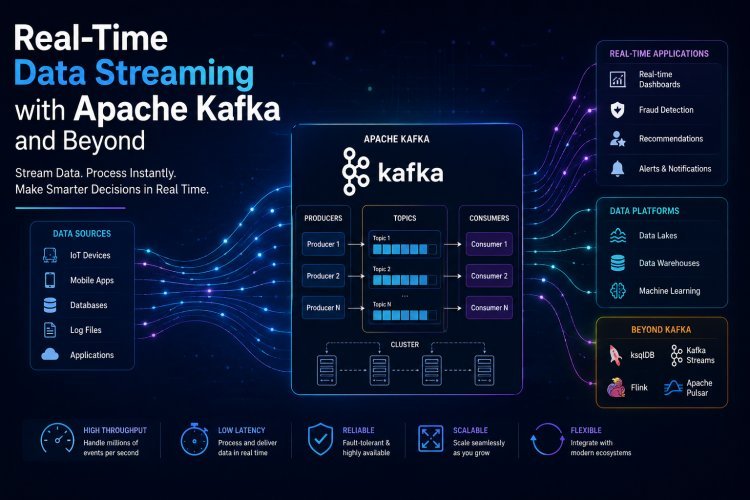
Kafka's architecture is built around several core abstractions that work together to provide a high-throughput, durable, and scalable streaming platform. Topics are logical categories to which messages are published and from which messages are consumed. Each topic is divided into partitions, which are ordered, immutable sequences of messages that serve as the unit of parallelism and scalability. Producers publish messages to specific partitions based on partitioning strategies including key-based hashing, round-robin distribution, or custom partition assignment. Consumers read messages from partitions in offset order, with each consumer maintaining its current position through committed offsets.
The broker cluster forms the core of a Kafka deployment, with each broker hosting a subset of topic partitions. Partition replication provides fault tolerance, with configurable replication factors ensuring that data survives broker failures. The leader-follower replication model designates one replica as the leader for each partition, handling all producer and consumer requests, while follower replicas replicate data from the leader for redundancy. In the event of a leader failure, a follower replica is elected as the new leader, and operations continue with minimal interruption.
Kafka's storage architecture uses a segmented log design where each partition's messages are written to sequential log segments on disk. This sequential write pattern enables high throughput by taking advantage of disk performance characteristics that favor sequential I/O over random I/O. Messages within a partition receive a monotonically increasing offset that uniquely identifies their position, enabling consumers to track their progress reliably. Log compaction retains the most recent message for each unique key, enabling use cases including table restoration and state reconstruction.
Stream processing transforms and enriches event streams in real time, enabling applications that react to data as it arrives. Kafka Streams is a lightweight stream processing library that runs as a Java application, providing exactly-once processing semantics, state management through local state stores, and fault tolerance through standby replicas and changelog topics. Apache Flink provides a more comprehensive stream processing framework with support for event time processing, complex event processing patterns, and efficient state management for large state sizes. ksqlDB enables stream processing through SQL queries, making real-time data transformation accessible to analysts and data scientists without Java development expertise.
Schema management ensures data compatibility across producers and consumers in streaming systems. The Confluent Schema Registry centralizes schema storage and validation, supporting Avro, JSON Schema, and Protobuf formats. Schema evolution rules define compatibility guarantees including backward compatibility, forward compatibility, and full compatibility, preventing incompatible changes from breaking downstream consumers. Schema registry integration with Kafka producers and consumers ensures that all messages are serialized and deserialized consistently, reducing data quality issues and integration failures.
Connector frameworks simplify integration between Kafka and external systems. Kafka Connect provides a framework for building and running connectors that move data between Kafka and data stores including databases, object storage, search indexes, and other message systems. Source connectors ingest data from external systems into Kafka topics, while sink connectors export data from Kafka topics to external systems. The open-source connector ecosystem includes hundreds of pre-built connectors for common data sources and destinations, dramatically reducing the integration effort required for streaming pipelines.
Benefits
Real-time data processing enables organizations to respond to events as they occur rather than hours or days later. E-commerce platforms use streaming to detect and respond to fraud attempts in milliseconds. Financial services firms process market data streams for algorithmic trading and real-time risk management. Manufacturing organizations monitor production line sensor data to detect anomalies and predict equipment failures before they cause downtime. The latency reduction from batch to real-time processing typically spans orders of magnitude, enabling entirely new classes of applications.
Data integration through streaming replaces brittle point-to-point connections with a central event backbone. Instead of building custom integrations between every pair of systems, organizations publish events to Kafka topics and allow any interested system to consume them. This decoupling reduces integration complexity, improves system resilience by eliminating direct dependencies, and makes it easier to add new data consumers without modifying existing producers. The central event backbone also provides a durable record of all events, supporting audit, compliance, and data lineage requirements.
Scalability and reliability of streaming platforms enable organizations to process data volumes that would be impractical with batch systems. Kafka clusters in production regularly process millions of messages per second, with petabytes of persistent storage. The distributed architecture ensures that throughput scales linearly with cluster size, and replication guarantees data durability even during hardware failures. Organizations that have built their data infrastructure around streaming report higher reliability and lower operational overhead compared to batch-based alternatives.
Unified batch and stream processing has become feasible as stream processing frameworks have matured. The kappa architecture proposes using a single streaming platform for both real-time and historical data processing, eliminating the need for separate batch and streaming systems. Changes to data processing logic are applied to the event stream, and results are recalculated by reprocessing historical data from the immutable event log. This approach simplifies architecture, reduces duplication, and ensures consistency between real-time and historical results.
Challenges
Operational complexity of self-managed Kafka deployments remains a significant challenge. Kafka clusters require careful configuration for optimal performance, with dozens of parameters affecting throughput, latency, durability, and resource utilization. Monitoring Kafka requires understanding of metrics including request latency, consumer lag, under-replicated partitions, and network throughput. Operating Kafka at scale demands specialized expertise that is scarce in the job market, leading many organizations to choose managed Kafka services despite their higher cost.
Exactly-once semantics, while theoretically achievable, introduce complexity in practice. Kafka's exactly-once processing guarantees require coordination between producers, brokers, and consumers that adds latency and operational overhead. The transactional API, idempotent producers, and exactly-once stream processing capabilities must be carefully configured and verified. Many organizations accept at-least-once delivery with deduplication at the consumer rather than investing in the operational complexity of exactly-once processing.
Cost management for streaming infrastructure requires careful capacity planning and resource optimization. Kafka's durability guarantees require data replication, increasing storage costs. High-throughput clusters require substantial memory, CPU, and network resources. The cost of managed Kafka services can be significant for high-volume use cases. Organizations must balance performance requirements against infrastructure costs, optimizing partition count, retention periods, and replication factors to achieve acceptable economics.
Data governance for streaming systems presents challenges that differ from traditional batch data governance. The real-time nature of streaming makes data quality validation more difficult because there is no opportunity for batch correction before data is consumed. Schema evolution must be managed carefully to avoid breaking downstream consumers. Data lineage tracking across streaming pipelines requires specialized tooling. The permanent event log creates data retention and privacy compliance requirements that must be addressed through topic lifecycle management and data deletion capabilities.
Industry Impact
The streaming data market has grown to exceed thirty billion dollars annually, spanning infrastructure platforms, managed services, stream processing frameworks, and streaming analytics tools. Every major cloud provider offers managed streaming services, and the open-source streaming ecosystem continues to expand with new projects and capabilities. Streaming has become a standard architectural pattern rather than an advanced technique used only by leading-edge technology companies.
Event-driven architecture has emerged as the dominant architectural style for new application development, with streaming infrastructure as its foundation. Organizations are adopting event-driven patterns for microservice communication, system integration, and user-facing features that require real-time responsiveness. The event backbone provided by Kafka and similar platforms enables the event sourcing and command query responsibility segregation patterns that are central to modern distributed system design.
The data engineering profession has evolved to include streaming as a core competency alongside batch processing. Data engineers working with streaming systems need skills in event-driven architecture, stream processing, schema management, and streaming platform operations that differ from traditional data warehouse and ETL expertise. The demand for engineers with streaming experience has grown rapidly, with streaming expertise commanding premium compensation.
Future Outlook
Streaming databases that combine stream processing with SQL querying represent a significant evolution in the streaming landscape. RisingWave, Materialize, and Apache Flink SQL enable organizations to treat streaming data as tables that can be queried with standard SQL, producing continuously updated results as new data arrives. These systems lower the barrier to streaming adoption by enabling analysts and data scientists to work with streaming data using familiar SQL interfaces rather than requiring Java or Scala stream processing expertise.
Unified streaming and batch platforms are converging toward architectures that handle both modes within a single system. Apache Flink has provided a true unified batch and streaming runtime since its early versions. Spark Streaming, while fundamentally a micro-batch system, has improved its latency characteristics. The convergence trend continues with Kafka as both a streaming platform and a distributed storage system for historical data, blurring the distinction between streaming and batch processing.
Streaming machine learning is emerging as a capability that combines real-time data processing with model inference. Organizations deploy machine learning models on streaming data for use cases including real-time fraud detection, dynamic pricing, personalized recommendations, and predictive maintenance. The integration of streaming platforms with ML serving infrastructure enables model inference at streaming latency and scale, with feature engineering and model scoring occurring within stream processing pipelines.
FAQ
Should we use Kafka or a managed streaming service like Confluent Cloud or Amazon MSK?
The choice depends on organizational capabilities and priorities. Self-managed Kafka provides lower costs at scale and more configuration flexibility but requires significant operational expertise. Managed services reduce operational overhead at higher unit costs and with some limitations on configuration options. Organizations with limited DevOps resources or streaming expertise typically benefit from managed services, while organizations with strong operational capabilities and very large-scale deployments may prefer self-managed clusters for cost optimization.
What is the difference between Kafka and a traditional message queue?
Kafka is designed for high-throughput, durable, replayable event streaming rather than point-to-point message delivery. Key differences include Kafka's persistent log-based storage that retains messages for configurable periods, its ability to replay messages by resetting consumer offsets, its horizontal scalability through partitioning, and its publish-subscribe model supporting multiple independent consumer groups. Traditional message queues typically delete messages after consumption and have lower throughput capabilities.
How do we choose between stream processing frameworks like Kafka Streams and Apache Flink?
Kafka Streams is a lightweight embeddable library that runs within your application, making it ideal for teams that want simple deployment and tight integration with Kafka. Apache Flink is a comprehensive stream processing framework with more advanced capabilities including event time processing, complex event processing, and efficient state management for very large state sizes. Choose Kafka Streams for simpler applications and for teams already familiar with Java. Choose Flink for complex processing requirements, large state, and use cases requiring sophisticated windowing and time-based operations.
How do we handle schema evolution in streaming systems?
Schema evolution is managed through a schema registry that stores and validates schemas used by producers and consumers. Establish compatibility rules that allow safe schema evolution, such as backward compatibility that ensures new schemas can be read by consumers using old schemas or forward compatibility that ensures old schemas can be read by consumers using new schemas. Follow the principle of adding optional fields rather than removing or changing required fields, and test schema changes against all downstream consumers before deployment.
What monitoring metrics are essential for Kafka operations?
Essential Kafka monitoring metrics include consumer lag measuring how far consumers are behind the latest messages, request latency for produce and fetch operations, under-replicated partition count indicating replication issues, broker CPU, memory, disk and network utilization, and garbage collection metrics for the JVM-based brokers. Proactive monitoring of these metrics enables early detection of issues before they cause service degradation or data loss.
Conclusion
Real-time data streaming with Apache Kafka and its ecosystem partners has become fundamental infrastructure for modern data-driven organizations. The ability to process, analyze, and act on data as it is generated enables applications and business processes that were impossible with batch-oriented approaches. Kafka's architecture, ecosystem, and operational maturity have established it as the central platform for event-driven architecture and real-time data integration.
The streaming data landscape continues to evolve with new technologies that address specific limitations of Kafka and extend the possibilities of real-time data processing. Organizations building streaming infrastructure should evaluate their specific requirements carefully, considering not only throughput and latency but also operational complexity, team expertise, and long-term maintainability. The investment in streaming infrastructure, while significant, delivers returns through improved operational efficiency, new revenue opportunities, and competitive advantages in speed of decision-making.
The most successful streaming implementations share common characteristics: clear understanding of event-driven architecture principles, investment in schema management and data governance, robust monitoring and operations practices, and incremental adoption starting with high-value use cases. Organizations that commit to these practices consistently achieve positive outcomes with real-time data streaming.
References
1. Kreps, J. et al. (2024). Kafka: The Definitive Guide. 3rd Edition. O'Reilly Media.
2. Narkhede, N. et al. (2023). Streaming Systems: Design and Implementation of Distributed Event-Stream Processing. ACM Books.
3. Hueske, F. and Kalavri, V. (2025). Stream Processing with Apache Flink. O'Reilly Media.
4. Shah, T. (2024). Real-Time Analytics: Techniques and Technologies for Streaming Data. Manning Publications.
5. Kleppmann, M. (2023). Data Streaming Systems: A Comprehensive Analysis. Communications of the ACM, 66(9), 56-68.
6. Akidau, T. et al. (2024). The Dataflow Model: A Practical Approach to Balancing Correctness, Latency, and Cost in Massive-Scale Data Processing. Proceedings of the VLDB Endowment, 17(4), 567-584.
7. Confluent Inc. (2025). The State of Data Streaming Report 2025. Confluent Technical Report.